



We all know one basic financial principle — currency is a depreciating asset. The money lying idle in your bank account or locker silently loses value every year due to inflation.
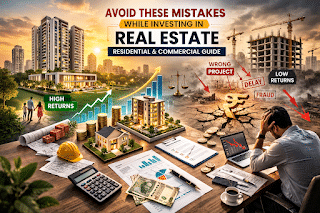
But what’s more dangerous than inflation is poor investment decisions. In the rush to grow money quickly, many investors enter the wrong project, with the wrong developer, and without understanding the market cycle. Instead of appreciation, their capital gets stuck — sometimes for years.
With over two decades of experience in real estate advisory, this blog is not about promoting any particular project. It is about highlighting the most common mistakes buyers make in residential and commercial real estate — and how you can avoid them.
Residential Property Investment: Where Most Buyers Go Wrong
1. Investing in Under-Construction Projects Without Proper Planning
Under-construction property is often attractive because of staggered payments. Instead of arranging a lump sum for a ready property, buyers can pay in phases during construction. This model genuinely helps in gradual wealth creation.
However, the biggest mistake happens when buyers enter the project based only on the booking amount (20–30%) and assume:
“Rates will increase, and I’ll exit easily.”
Markets don’t move in one direction forever. Demand can slow down. Resale buyers may not appear. Prices can stagnate.
If exit doesn’t happen, the remaining installments become a financial burden. And if funds are not available at that stage, investors are forced to sell under pressure — often below their purchase price.
The Golden Rule:
Invest in under-construction property only if you have at least 75% holding capacity.
Typically, builders demand around 70–75% payment by the superstructure stage. At that point, the project is physically visible, making resale easier and giving you adequate time to plan.
Remember:
Under-construction creates wealth only for investors who can hold.
Exit is an option — not a strategy.
2. Ignoring Product-Market Fit
Every month, new residential projects are launched. But not every project is investment-worthy.
A residential property must suit:
The micro-market
The surrounding ecosystem
The target buyer profile
For example, launching ultra-large luxury apartments in traditionally affordable zones creates a demand mismatch. Even if construction quality is good, resale and appreciation may struggle due to limited buyer base.
Developers like Sobha Limited are known for aligning unit sizes with demand absorption trends. Strategic developers study the buyer segment first and design inventory accordingly.
Similarly, developments by Experion Developers in IT-driven sectors are positioned around working professionals, ensuring stronger demand consistency.
At the ultra-luxury end, projects like Gaur Trecento in Jaypee Greens are designed specifically for golf-course lifestyle buyers. Large residences, premium layouts, and ecosystem alignment create stronger long-term positioning.
Thumb Rule:
A residential project succeeds when it fits its market, neighbors, and buyer psychology.
3. Over-Prioritizing Location While Compromising on Quality
Many buyers believe location is everything. In trying to fit their budget into a prime sector, they compromise on:
Construction quality
Layout planning
Builder credibility
Maintenance standards
Real estate value is not built on location alone. It is a combination of:
Location + Execution + Product Quality + Developer Credibility
Sometimes, waiting for a better product or choosing a slightly peripheral location with superior construction is a smarter long-term decision.
Compromising on location can be strategic.
Compromising on quality is expensive.
Commercial Property Investment: Where Most Investors Get Trapped
Commercial real estate appears attractive because the entry ticket can start as low as ₹20–25 lakhs. But this segment is far more sensitive to execution and management than residential property.
Only a small percentage of commercial projects truly perform well.
1. Ignoring Builder’s Long-Term Involvement
In commercial property, the builder’s intention matters more than the brochure.
If a developer sells all units and exits the project, leasing becomes fragmented. Strong brands prefer dealing with a single authority rather than multiple small shop owners.
Successful commercial assets require:
Centralized leasing
Active post-possession management
Long-term builder stake
Without structured leasing and brand positioning, even a good location can struggle.
2. Not Evaluating Leasing Structure
Commercial real estate performance depends on:
Footfall
Tenant mix
Brand positioning
Asset management
Projects where the builder retains control over leasing generally perform better in rentals and resale compared to fragmented ownership structures.
Execution defines commercial success — not just construction.
3. Investing in Small Unlockable Units Without Exit Planning
200–200 sq.ft. unlockable commercial spaces are heavily marketed due to lower investment size. They may generate rental income in centralized leasing models, but resale is often challenging.
In projects where lockable units are meant for self-use and unlockable units depend on rental pooling, liquidity becomes a concern.
Many investors later struggle to exit such units because:
Buyer demand is limited
End-users prefer ownership control
Fragmented leasing reduces resale confidence
In commercial property, liquidity matters as much as rental yield.
Final Thoughts
Real estate is a powerful wealth-building asset class — but only when approached with discipline and strategy.
Key Reminders:
Never invest in under-construction without holding capacity.
Exit should never be your primary plan.
Ensure product-market alignment.
Never compromise on builder quality.
In commercial property, builder involvement and leasing control are critical.
Think about resale before buying — not after.
Real estate rewards patience, research, and financial strength. It does not reward impulsive decisions.